Forward
The conversation about the future of finance tends to fixate on technology, on which chain or protocol will prevail. We would argue that the more decisive question is a quieter one. Whose law does the infrastructure ultimately answer to? We examine sovereignty not as rhetoric but as a precise, technical property, the quality of infrastructure that rests on a legal foundation no external power can override, and explain why Liechtenstein offers a configuration of legal, regulatory, and jurisdictional attributes that cannot be manufactured through engineering alone. From there we trace how that sovereign foundation reaches all the way down to the individual transaction, where verifiable credentials resolve to a governed root and compliance is enforced before value moves rather than remediated after. The result is a model in which trust is a property of the system itself, open enough for anyone to participate yet credentialed enough for institutions to rely on. This is the ground LTIN is built on, and the reason it is designed to endure beyond any single technology cycle.
There is a tendency, when people describe the future of finance, to begin with technology. Which network will prevail, which protocol will scale, which settlement layer will carry the weight of institutional value. These are important questions, yet not fundamental. The fundamental question is rarely asked with the depth it deserves. When financial infrastructure of consequence is built, whose law does it ultimately answer to?
This question sits at the centre of everything LTIN is. It is not a marketing frame or a matter of positioning. It is a structural observation about how trust is created, where it comes from, and what makes it durable enough to carry an economy. To understand why sovereignty is the organising principle of LTIN, it helps to begin not with the technology, but with the nature of the problem the technology is meant to solve.
The problem beneath the problem
Every financial transaction rests on an answer to a single question. Who is this? Before value can move, before compliance can clear a payment, before a counterparty can be relied upon, someone must be able to establish identity with certainty. When that answer is available and trustworthy, the system functions quietly. When it is missing, or arrives too late, the entire apparatus of finance compensates for its absence. Institutions build elaborate remediation processes for transactions that should never have occurred. Compliance becomes a function performed after the fact rather than a property established before it.
For most of the history of digital finance, the answer to this question has been forced into an uncomfortable choice. A system could be open, meaning anyone could participate, but in that openness the identity of participants was uncertain. Or a system could be closed, meaning identity was known, but access sat behind a gatekeeper with the power to grant or withhold it. Open but untrusted, or trusted but controlled. This was presented as an inevitable trade-off, a law of nature rather than an artefact of how the systems happened to be built.
It is not a law of nature. The trade-off dissolves the moment identity is anchored to a standard the whole market recognises, issued in a way that is verifiable by anyone, and grounded in a legal order that cannot be quietly overridden. This is the category LTIN exists to build. We describe it as credentialed permissionless. The network remains open. Participants carry verifiable credentials that establish who they are. And crucially, the trust those credentials carry does not depend on any single company vouching for them. It depends on the standard, and on the sovereign foundation beneath the standard.
What sovereignty actually means here
Sovereignty is a word that is easily misused. In the context of LTIN it has a precise and technical meaning, and it is worth stating carefully. Sovereignty refers to the quality of infrastructure that is bound to a legal order capable of protecting it, and beyond the reach of legal orders that would compromise it. It is the difference between infrastructure that exists at the discretion of a power that could reach into it or switch it off, and infrastructure that rests on a foundation no external authority can override.
This matters because identity infrastructure is not like other software. When an ordinary application is hosted in a particular jurisdiction, the consequences of that choice are usually modest. When the root of trust for financial identity is hosted somewhere, the jurisdiction becomes part of the infrastructure itself. Whoever holds legal authority over the place where credentials are issued and anchored holds a form of authority over the credentials. A root of trust that can be compelled, seized, or disabled by an external power is not a root of trust at all. It is a dependency wearing the costume of one.
Why Liechtenstein
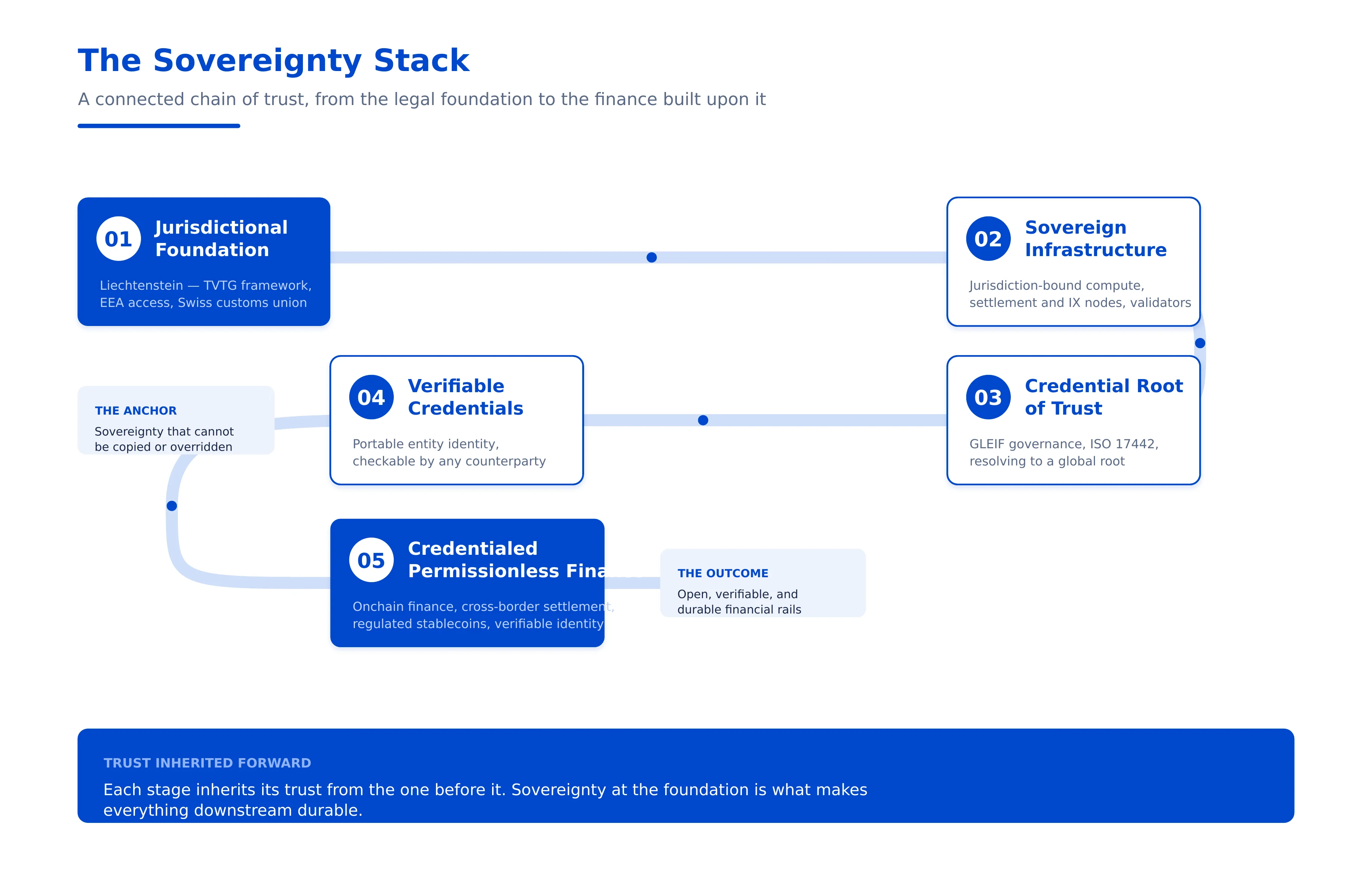
The choice of jurisdiction is therefore not incidental to LTIN. It is foundational. Liechtenstein occupies an exceptional position in the architecture of European and global finance, and that position is difficult, perhaps impossible, to replicate elsewhere. It combines a clear and forward-looking legal framework for tokenised and distributed systems, established through its TVTG legislation, with membership of the European Economic Area and the market access that carries. It sits within the Swiss customs union, giving it a settlement and trade posture aligned with Switzerland. And it stands outside the reach of extraterritorial legal instruments, such as the CLOUD Act, that would otherwise allow a foreign power to compel access to infrastructure hosted within it.
Each of these attributes is valuable on its own. Held together, in a single jurisdiction, they form something that cannot be manufactured through technology alone. No amount of engineering can create a sovereign. No protocol can vote itself a legal order. This is the essential point about sovereignty as a foundation for infrastructure. It is one of the very few properties in the entire stack that cannot be copied, forked, or subsidised into existence. It must be held, and Liechtenstein holds it in a configuration that is close to unique.
This is what allows LTIN to occupy a position that pure technology projects cannot. A blockchain can be replicated. A protocol can be re-implemented. A standard can be adopted by anyone. But the combination of a credentialing authority operating under a specific and durable legal order, anchored in a jurisdiction chosen precisely for its sovereignty, is not a feature that a competitor can add to a roadmap. It is a structural position, and structural positions are what endure.
The Geopolitical Moment
There is a reason this matters more now than it would have a decade ago. The relationship between technology and national power has changed. For much of the early history of the internet, digital infrastructure was treated as broadly neutral, a set of services that happened to be hosted somewhere but whose location carried little consequence. That assumption has quietly collapsed. Governments now understand that control over digital infrastructure is a form of strategic leverage, and they act accordingly. Data localisation requirements, extraterritorial legal reach, and the treatment of technology platforms as instruments of policy have all become ordinary features of the landscape.
In this environment, the question of whose law an infrastructure answers to is no longer abstract. For financial infrastructure in particular, where the stakes involve the movement of capital and the identity of regulated entities, the jurisdiction beneath the system becomes a first-order concern. An institution deciding whether to rely on a piece of financial infrastructure is, whether it frames it this way or not, deciding whether to accept the legal order that governs that infrastructure. Increasingly, sophisticated institutions are asking that question explicitly, and they are right to.
Sovereignty, understood in this way, is not a defensive posture. It is a competitive one. Infrastructure that can credibly demonstrate independence from external legal compulsion offers something that infrastructure hosted within a major power simply cannot, no matter how excellent its engineering. It offers neutrality that is structural rather than promised. For the parties who most need that neutrality, and they are the parties who matter most in institutional finance, it is not a nice-to-have. It is the precondition for participation.
From foundation to transaction
It would be a mistake to leave the impression that sovereignty is only a matter of where things are hosted. Its real significance appears at the level of the transaction, in the way trust is established and enforced at the moment value moves. This is where the abstract foundation becomes concrete, and where the value of the arrangement becomes visible.
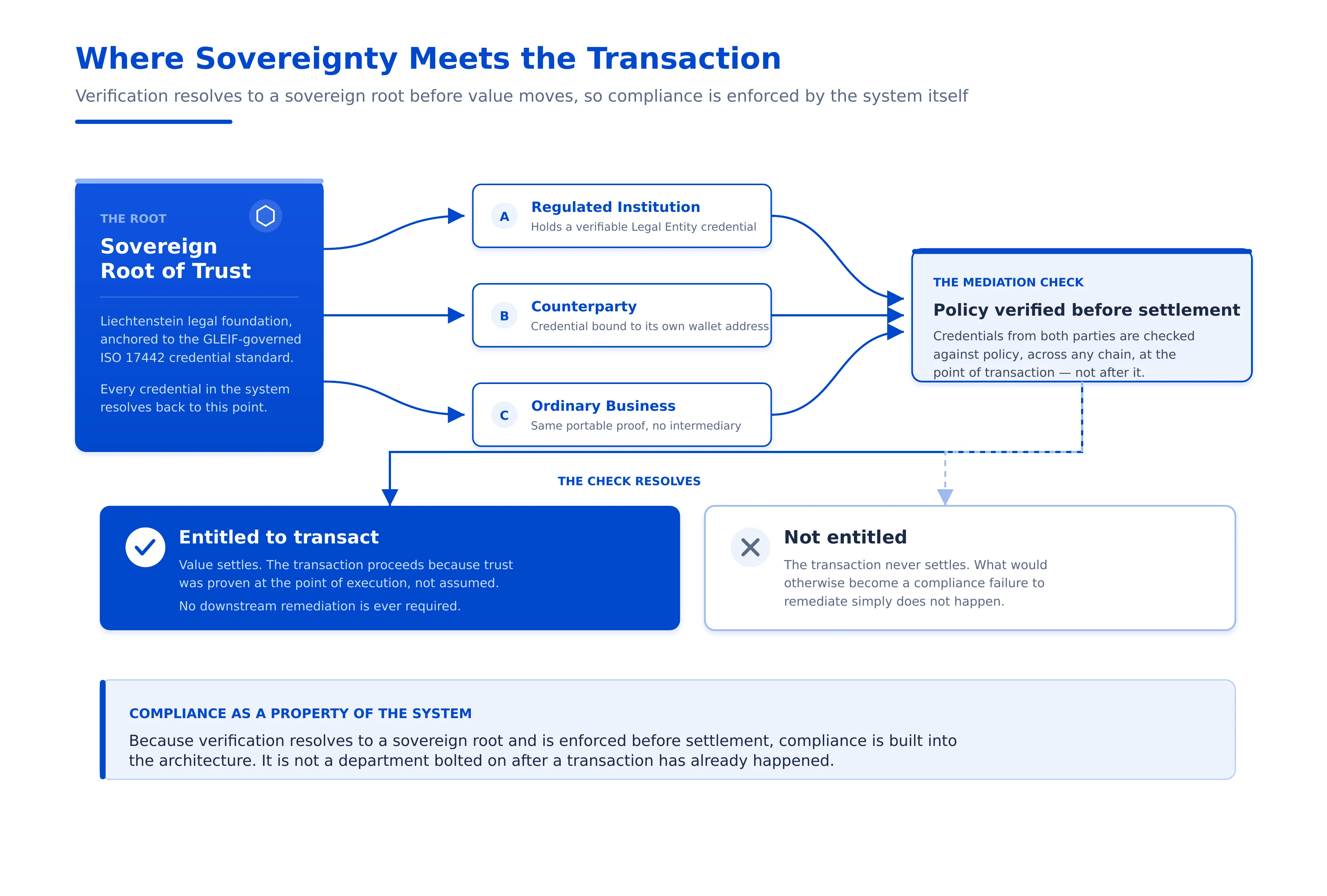
This is the sense in which compliance becomes a property of the system rather than a department bolted onto it. The discipline is enforced in the architecture, at the root, and inherited by everything that runs on top. And the reason this can be trusted at institutional scale is that the root itself is sovereign. The whole structure holds because its foundation cannot be moved.
What LTIN intends to be
It follows from all of this that LTIN does not think of itself as a product competing for a cycle. Products win attention for a season and are then replaced by the next iteration. The ambition here is different and, we would argue, more durable. LTIN intends to be the sovereign foundation on which credentialed permissionless finance is built. Not a participant in someone else's reference, but the source that references point back to. Not a system that asks the market to trust it, but one that anchors trust in standards and in a legal order the market already recognises.
This ambition is deliberately modest in one respect and expansive in another. It is modest because LTIN does not seek to invent the standards it relies upon. The credential framework it works within is governed globally and defined independently, and that independence is precisely the point. Legitimacy cannot be self-certified. It has to rest on institutions and standards the whole market already trusts. LTIN’s role is to bring those standards into use, enforceably and at scale, on a foundation sovereign enough to make them durable.
It is expansive because the implications reach well beyond any single institution or use case. If the foundation is right, the range of what can be built on top of it is very large. Regulated onchain finance, cross-border settlement, verifiable business identity, and applications not yet imagined all become possible when identity is anchored, verifiable, and sovereign. The banks will benefit, but they were never the whole of it. The deeper consequence is for the far larger population of businesses and institutions that have been underserved by a financial system that could not verify them efficiently, and that could not offer them infrastructure genuinely independent of external control.
The Question that remains
The next financial system is being built now, in real time, by many hands and in many places. Much of the attention falls on the visible layer, the chains and protocols and applications that are easiest to point to. But the question that will determine which of these endures is quieter and more fundamental than any of them. It is the question of whose law the system ultimately answers to, and whether its foundation can be trusted to hold when it matters most.
LTIN was built to answer that question precisely. Not by asking anyone to take our word for it, but by anchoring identity to global standards, enforcing trust before settlement rather than after, and grounding the whole of it in a jurisdiction chosen for the durability of its sovereignty. Everything in finance is downstream of a single question. We have simply chosen to build where the answer can be trusted to last.